
Women in the Church: Called, Gifted, and Needed
- Chris Gambrell

- 1 day ago
- 15 min read

A Scripture-led look at women, leadership, teaching, and the office of elder.
The Bible does not silence women or push them to the edges of the church. It presents them as image-bearers, disciples, witnesses, teachers, and coworkers in the gospel.
A Conversation I Never Wanted to Have
I never wanted to write about women serving in church leadership.
This subject has produced division, anger, and pain in many churches. It is often discussed as though men and women are competing for influence, authority, or importance. Some speak about it with unnecessary harshness. Others treat every biblical distinction as an attack upon women.
Caught in the middle are faithful Christian women who love Christ, love Scripture, and sincerely want to serve Him.
I did not want to add to the noise.
I did not want to write something that would make women feel unwanted, inferior, or pushed to the edges of the church. I also did not want to avoid difficult passages merely because they are controversial. Silence can feel safer, but silence does not always serve people well.
Eventually, I became convinced that the subject needed to be addressed.
Not because I wanted to tell women what they could not do.
Not because I wanted to defend a tradition simply for being familiar.
Not because I wanted to win an argument.
I wanted to understand what Scripture actually says.
How does God view women? How did Jesus treat them? How did women participate in the ministry of the early church? What gifts has the Holy Spirit given them? Are there boundaries concerning particular church offices? If there are, what do those boundaries mean, and what do they not mean?
I approach these questions with conviction, but also with humility. I could be wrong in some of my conclusions. Faithful Christians who love Scripture have reached different positions. I do not believe disagreement automatically proves rebellion, compromise, or contempt for God’s Word.
I desire to listen carefully to Scripture and follow where it leads.
This conversation should not begin with what women may or may not do.
It should begin with who women are in God's sight.
Created in the Image of God
The Bible’s first declaration about women is not a restriction. It is a declaration of dignity.
“God created mankind in His own image;He created him in the image of God;He created them male and female.”Genesis 1:27
Both men and women were created in the image of God.
Men do not reflect God’s image more fully than women. Women are not secondary image-bearers, lesser creations, or spiritual assistants to men.
God blessed both the man and the woman. He commanded them to fill the earth, subdue it, and exercise responsible dominion over creation. From the beginning, God’s work in the world was entrusted to humanity as male and female.
Genesis 2 tells us that God placed Adam in the garden. Yet God then declared:
“It is not good for the man to be alone. I will make a helper corresponding to him.”Genesis 2:18
The word translated “helper” does not describe an inferior servant. The same Hebrew word is repeatedly used of God as the helper of His people.
Eve was created as a corresponding partner, someone uniquely suited to stand with Adam in fulfilling God’s purpose.
The woman was not created because the man was already complete and merely needed an assistant. She was created because something essential was missing.
God did not say the man’s loneliness was inconvenient.
He said it was not good.
From the opening chapters of Scripture, women are presented as necessary participants in God’s design. Any theology that makes women feel unnecessary has failed to reflect the goodness of creation.
Women Whom God Used
Throughout Scripture, God entrusted women with wisdom, courage, responsibility, spiritual influence, and leadership.
Miriam was called a prophetess and helped lead Israel in worship after God delivered His people through the Red Sea.
Deborah was both a prophetess and a judge. The people of Israel came to her for judgment, and she communicated God’s command to Barak during a national crisis.
Huldah delivered the word of the Lord to representatives of King Josiah after the Book of the Law was discovered in the temple.
Esther risked her life before the king and helped rescue her people from destruction.
Abigail acted with courage and discernment when her husband’s foolishness placed their household in danger. Her wisdom prevented David from committing needless bloodshed.
The woman described in Proverbs 31 manages property, conducts business, provides for her household, cares for the poor, speaks wisdom, and teaches faithfully.
These women did not all hold the same role. Scripture does not erase the differences between prophets, judges, queens, mothers, teachers, servants, and leaders.
Yet their lives reveal something important.
God does not view female wisdom, courage, leadership, or spiritual insight as a threat.
The Bible does not portray faithful women as passive shadows standing behind important men. It presents them as servants of God whose obedience changed families, communities, and nations.
Jesus Welcomed Women as Disciples
Jesus entered a world in which women were often overlooked, dismissed, or valued primarily according to their relationship to men.
Yet He consistently recognized their dignity, faith, intelligence, and spiritual responsibility.
Women traveled with Jesus and the Twelve and supported His ministry from their own resources.
Mary of Bethany sat at Jesus’ feet and listened to His teaching. Sitting at the feet of a teacher was the posture of a disciple. When Martha protested, Jesus did not send Mary away from His teaching. He defended her decision to learn from Him.
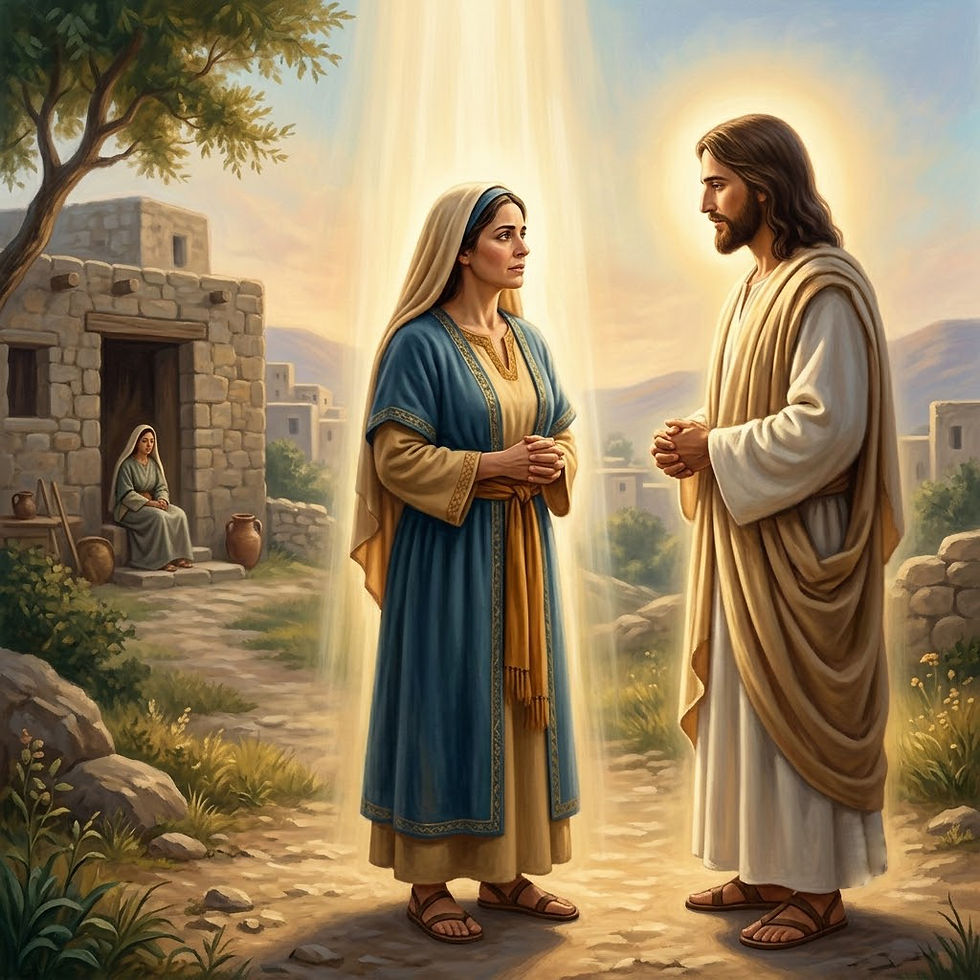
Jesus spoke openly with the Samaritan woman, crossing social, ethnic, moral, and religious boundaries. He discussed worship and the nature of God with her. She then returned to her community and told others about Him. Many came to investigate Jesus because of her testimony.
Jesus received the worship of women. He commended their faith. He healed them publicly. He defended them from humiliation. He welcomed them as disciples.
Women remained near the cross when many others fled. Women witnessed where Jesus was buried. Women were the first to discover the empty tomb.
The risen Christ entrusted women with the announcement that He was alive.
This does not automatically answer every question concerning church office. It does, however, destroy the idea that women belong at the edges of Christ’s mission.
Women were learners, supporters, witnesses, messengers, and disciples.
The Holy Spirit Gifts Women
At Pentecost, Peter explained the outpouring of the Holy Spirit by quoting the prophet Joel:
“Your sons and your daughters will prophesy.”Acts 2:17
He continued:
“I will pour out My Spirit on My servants in those days, both men and women, and they will prophesy.”Acts 2:18
The Holy Spirit was not poured out upon men while women watched from a distance.
Sons and daughters received the Spirit.
Men and women were empowered to bear witness to Christ.
Paul teaches that manifestations of the Spirit are given for the good of the church:
“A manifestation of the Spirit is given to each person for the common good.”1 Corinthians 12:7
Peter similarly writes:
“Just as each one has received a gift, use it to serve others, as good stewards of the varied grace of God.”1 Peter 4:10
Spiritual gifts are expressions of God’s grace, given so that believers may serve one another.
This means the church has a responsibility not only to recognize biblical boundaries, but also to recognize biblical gifts.
A church can become so focused on preventing women from crossing a boundary that it fails to recognize what God has placed within them. When this happens, neglect can begin to masquerade as faithfulness.
But burying God-given gifts is not faithfulness.
Women who are gifted in teaching should be equipped to teach within biblical contexts. Women gifted in leadership should be entrusted with meaningful responsibility. Women gifted in mercy, administration, evangelism, hospitality, discernment, counseling, wisdom, encouragement, or service should be given room to serve.
The church needs what the Spirit gives through women.
Women Taught and Served in the Early Church
The New Testament does not teach that women are incapable of explaining Scripture or communicating theological truth.
Priscilla and Aquila encountered Apollos, an eloquent preacher whose understanding was incomplete. Together, they took him aside and explained the way of God to him more accurately.
Priscilla participated in the theological instruction of a man who was already teaching publicly. The passage does not portray her involvement as improper.
Older women are commanded to teach what is good and train younger women in faithful Christian living. This is not insignificant work. It involves truth applied to character, marriage, family, self-control, love, and discipleship.
Timothy’s faith was shaped by his mother, Eunice, and his grandmother, Lois. Paul reminded him that he had known the sacred Scriptures from childhood. These women helped form the faith of a man who became one of Paul’s closest coworkers.
Paul also describes several women as fellow workers in the gospel.
Phoebe is called a servant, or possibly a deacon, of the church at Cenchreae. Paul entrusted her with significant responsibility and instructed the Christians in Rome to assist her in whatever she needed.
Priscilla is called Paul’s coworker in Christ Jesus.
Euodia and Syntyche labored beside Paul in the work of the gospel.
Lydia opened her home, which became a gathering place for believers in Philippi.
Junia is remembered with honor in Romans 16 and described with language associated with apostolic or missionary service. The precise meaning of Paul’s description is debated, but her importance in the early church should not be minimized.
Paul did not treat these women as spiritual spectators.
They were servants, teachers, benefactors, hosts, witnesses, and coworkers.
The Difficult Passages Must Still Be Heard
Recognizing the gifts and ministries of women does not permit us to avoid difficult passages.
Paul writes:
“Let a woman learn quietly with full submission. I do not allow a woman to teach or to have authority over a man; instead, she is to remain quiet.”1 Timothy 2:11–12
This passage has been interpreted in several ways.
Some believe Paul was primarily confronting false teaching among particular women in Ephesus.
Others argue that the word translated “have authority” refers to domineering, abusive, or improper conduct rather than ordinary authority.
Others understand Paul to be giving a continuing instruction concerning the teaching and governing authority of the church.
The surrounding verses matter. Paul refers to Adam and Eve, suggesting that his reasoning is not based entirely upon a temporary local situation.
At the same time, the passage cannot mean that women must never speak, pray, teach, testify, or offer spiritual instruction.
Paul acknowledges women praying and prophesying in 1 Corinthians 11. Priscilla helped instruct Apollos. Older women were commanded to teach. Believers throughout the church were instructed to teach and admonish one another.
The question, therefore, is not simply, “May a woman ever teach?”
Scripture shows that women did teach.
The deeper question is whether Paul is reserving a particular kind of governing and doctrinally accountable teaching for the elders of the church.
The Office of Elder
The New Testament uses the terms elder, overseer, and shepherd in closely connected ways.
In Acts 20, Paul summoned the elders of the church in Ephesus. He told them that the Holy Spirit had made them overseers and instructed them to shepherd the church of God.
Peter similarly told elders to shepherd God’s flock while exercising oversight.
The elders were responsible for teaching sound doctrine, protecting the congregation from error, overseeing its spiritual health, shepherding believers, and living as examples to the flock.
The qualifications for elders in 1 Timothy 3 and Titus 1 are expressed in male and marital language. An elder is described as the husband of one wife, someone who leads his household faithfully, possesses proven character, and can teach.
Faithful Christians interpret these passages differently. I do not believe that every Christian who reaches an egalitarian conclusion is rejecting Scripture.
However, after considering Paul’s reasoning, the qualifications for elders, and the broader New Testament pattern, I believe the governing and doctrinally accountable office of elder or overseer is entrusted to qualified men.
That conclusion does not rest upon the belief that men are smarter, holier, wiser, or more gifted than women.
Scripture provides abundant evidence that women may surpass men in wisdom, courage, maturity, faithfulness, and theological understanding.
Eldership is not a prize awarded to the most valuable Christian.
It is a particular responsibility within the body of Christ.

Is the Boundary Only the Lead Pastor?
Modern churches often use titles that do not appear in the New Testament.
Some churches have a lead pastor, executive pastor, teaching pastor, worship pastor, youth pastor, care pastor, and discipleship pastor. Other churches use the word pastor for nearly every ministry leader.
Because these titles are used so differently, the word “pastor” alone may not tell us whether someone is functioning as a biblical elder.
A woman might be called a pastor while serving in a role that does not involve congregational oversight or elder authority.
A man might avoid the title of pastor while exercising every responsibility associated with eldership.
The title can become fog. The responsibilities reveal the office.
The more important questions are these:
Does this person exercise governing oversight over the congregation?
Is this person responsible for guarding the doctrine of the church?
Is this person recognized as an elder or overseer?
Does this person bear shepherding responsibility for the spiritual condition of the flock?
Does this person carry the regular, authoritative teaching responsibility attached to eldership?
For this reason, the biblical boundary may not apply only to the person called the lead pastor. It appears to concern the office of elder and the responsibilities belonging to that office.
At the same time, we should not label every form of leadership, instruction, or public speaking as eldership.
A woman leading a ministry team is not necessarily functioning as an elder.
A woman teaching a class is not automatically claiming governing authority over the church.
A woman sharing a testimony, explaining a passage, participating in a discussion, reading Scripture, leading worship, offering biblical encouragement, or addressing a ministry need is not necessarily occupying the pastoral office.
Churches should seek biblical wisdom rather than creating restrictions Scripture never created.
What About Women Preaching?
This may be the most difficult practical question in the discussion.
The New Testament does not give us a modern order of worship. It does not speak in our categories of Sunday sermons, guest speakers, ministry directors, teaching pastors, or church platforms. For that reason, we must be careful not to treat our traditions as though they were written directly into the biblical text.
Some complementarians believe that any sermon delivered to the gathered church is necessarily an exercise of elder authority. Under that view, a woman should never preach to a congregation containing men.
Others believe that the office of elder is reserved for qualified men, while recognizing that women may teach Scripture, address the congregation, or instruct mixed groups in settings where they are not functioning as elders.
After examining the passages, my present position is this:
I believe the office of elder or overseer should be held by qualified men. I also believe the regular preaching and doctrinal oversight of the gathered church should remain connected to those elders. Therefore, I would not appoint a woman as an elder, lead pastor, or regular preaching pastor of a congregation.
At the same time, I do not believe Scripture requires women to remain silent or prevents them from offering biblical instruction whenever men are present.
I believe women may:
lead ministries and ministry teams,
teach women and children,
teach Bible studies and classes,
participate in mixed-group discussions,
explain Scripture in appropriate settings,
disciple and counsel women and, where appropriate, married couples or families,
share testimonies,
read Scripture publicly,
lead prayer,
participate in worship,
report on ministry and missions,
offer biblical encouragement to the congregation,
and speak publicly when doing so does not place them in the governing office or regular doctrinal role of an elder.
I would also distinguish between an occasional address and the regular preaching ministry of the church.
A woman sharing her testimony, explaining a ministry, teaching during a special gathering, participating in a discussion, or offering biblical encouragement is not necessarily functioning as an elder. Standing on a platform does not automatically create pastoral authority. A pulpit is furniture, not an office.
However, when someone becomes the church’s regular preacher, exercises continuing doctrinal authority, and bears responsibility for shepherding the congregation through the public ministry of the Word, that person is functioning in a way closely connected to eldership. I believe that responsibility should be entrusted to qualified men.
This means I would not prohibit a woman from ever addressing a mixed congregation. Scripture gives us examples of women praying, prophesying, testifying, explaining truth, and working alongside men in the gospel. I do not believe those examples should be erased by turning every form of public speech into eldership.
At the same time, I would not separate the church’s regular preaching ministry from the elders who are responsible for its doctrine and spiritual oversight.
Women may exercise meaningful leadership and biblical teaching throughout the church, but the office of elder and the regular, governing preaching ministry attached to that office should be entrusted to qualified men.
I recognize that sincere Christians may draw the practical boundary differently. Some will believe this position permits too much. Others will believe it permits too little.
My intention is not to create the narrowest possible space in which women may serve. Nor is it to erase a distinction that Scripture appears to establish.
My desire is to honor both truths:
God has established order within His church, and God has given women gifts that His church genuinely needs.
We should not sacrifice one truth in our attempt to defend the other.
What Male Eldership Does Not Mean
Reserving the office of elder for qualified men does not mean that every man has authority over every woman.
The New Testament does not establish universal male rule.
A woman is not required to submit to every man simply because he is male.
It does not mean men are natural leaders while women are natural followers.
Some men are poor leaders. Some women possess extraordinary leadership ability.
It does not mean women should remain silent in church.
It does not mean women cannot study theology, explain Scripture, write books, serve as missionaries, lead ministries, counsel believers, direct organizations, participate in decision-making, or influence the spiritual direction of the church.
It does not mean a woman’s highest calling is marriage or motherhood.
Marriage and motherhood are honorable callings, but unmarried women and women without children are not incomplete Christians. Their identity and purpose are found in Christ.
It does not mean male leaders may ignore the wisdom of women.
An elder board that never seriously listens to women may be entirely male while remaining spiritually foolish.
It does not mean men may dominate, belittle, frighten, patronize, or control women.
Jesus defines godly leadership through sacrifice and service:
“Whoever wants to become great among you will be your servant.”Matthew 20:26
Any man who uses biblical teaching to inflate his importance has contradicted the character of the One he claims to represent.
Women Can Exercise Meaningful Leadership
Women can lead in ways that are real, consequential, and deeply important to the life of the church.
They may lead ministries, disciple believers, counsel those who are suffering, organize outreach, direct mercy ministries, coordinate missions, teach women, instruct children, mentor younger believers, oversee administration, lead worship teams, write theological material, engage in apologetics, serve as missionaries, and help guide the church through wisdom and discernment.
Depending on how a church understands Romans 16:1 and 1 Timothy 3:11, women may also serve in the office of deacon.
These responsibilities should not be presented as consolation prizes for women who are excluded from the role that supposedly matters most.
The church is a body, not a ladder.
Eldership is not the gold medal of Christianity. It is one responsibility among many within the body of Christ.
Paul writes that the eye cannot say to the hand, “I don’t need you.”
No faithful elder should say to the women of the church, through either words or actions, “We do not need what God has given you.”
A church that honors women will do more than thank them for filling volunteer schedules:
It will help them discover, develop, and use their gifts.
It will invite their wisdom.
It will listen to their concerns.
It will protect them from abusive leadership.
It will take their theological questions seriously.
It will recognize their contributions.
It will provide meaningful opportunities to serve.
It will not treat women as dangers to be contained, but as sisters whose faithfulness strengthens the whole body.
A Word to Women
To the women who love Christ and desire to serve Him, your value is not determined by a title:
You are not less important because you are not an elder.
You are not spiritually invisible.
You are not a secondary member of Christ’s body.
You bear the image of God.
Christ shed His blood for you.
The Holy Spirit dwells within you.
You have been given gifts that the church needs.
Your prayers matter.
Your wisdom matters.
Your testimony matters.
Your leadership matters.
Your service matters.
Your knowledge of Scripture matters.
Your faithfulness may shape people and generations you will never fully see.
Some of the most influential servants in the history of the church never held formal office. God measures greatness differently than institutions do. His kingdom often advances through quiet obedience, courageous witness, patient discipleship, generous service, and truth spoken at the right moment.
Do not allow a church to convince you that there is no place for your gifts.
At the same time, remember that no title is necessary for a life of powerful ministry.
Our goal is not status.
Our goal is faithfulness to Christ.
A Word to Men and Church Leaders
Men must not use complementarian theology as an excuse for passivity.
If leadership is a responsibility entrusted to qualified men, then men should tremble before that responsibility rather than boast about it.
Biblical leadership requires sacrifice, character, patience, courage, humility, gentleness, and accountability.
It is not permission to control others.
Church leaders should ask themselves difficult questions:
Are we actively developing the gifts of women?
Do women have meaningful opportunities to contribute?
Do we listen when women identify problems?
Are women safe bringing concerns about male leaders?
Do our ministry structures communicate that only platform roles matter?
Have we created restrictions Scripture never created?
Are we willing to receive correction and wisdom from women?
A church may claim to honor women while rarely listening to them.
It may praise motherhood while neglecting single women.
It may speak of protecting women while protecting abusive men.
It may defend male leadership while expecting women to perform most of the ministry.
That is not biblical faithfulness.
Men who lead must lead as Christ did. They must use responsibility to serve, protect, equip, and strengthen others.
Faithful Together
The Bible does not silence women or relegate them to the edges of the church.
It presents women as image-bearers, disciples, prophets, teachers, witnesses, benefactors, servants, missionaries, and coworkers in the gospel.
The Holy Spirit gives gifts to women for the good of the whole church. Those gifts should be welcomed, cultivated, and used.
At the same time, I believe the New Testament entrusts the governing and doctrinally accountable office of elder or overseer to qualified men.
I hold that conclusion not because women are less capable, less spiritual, or less valuable, but because I am attempting to follow the pattern I see in Scripture.
That distinction must never be used to diminish women, silence their wisdom, excuse male passivity, or protect abusive leadership.
The church does not honor God by ignoring His order.
Neither does it honor God by burying His gifts.
We need men who lead with the sacrificial character of Christ.
We need women who are encouraged and equipped to serve with the gifts of the Spirit.
We need churches in which men and women are treated with dignity, called to holiness, and invited into meaningful participation in Christ’s mission.
Men and women are not competitors for importance.
We are members of one body, servants of one Lord, recipients of one Spirit, and witnesses to one gospel.
The question should never be, “How little may women do?”
How can every member of Christ’s body faithfully use everything God has given them within the order, freedom, and grace revealed in His Word?



Comments