
The Hidden Architecture of God's Work

There is a persistent assumption in the life of faith that the most important things happen all at once. A flash of light. A voice from heaven. A moment so disorienting and undeniable that everything before it becomes a different country. And there is truth in that—Scripture does not shy away from the sudden. What it resists, consistently and with intention, is the idea that the sudden is where the real work happens.
The real work is quiet.
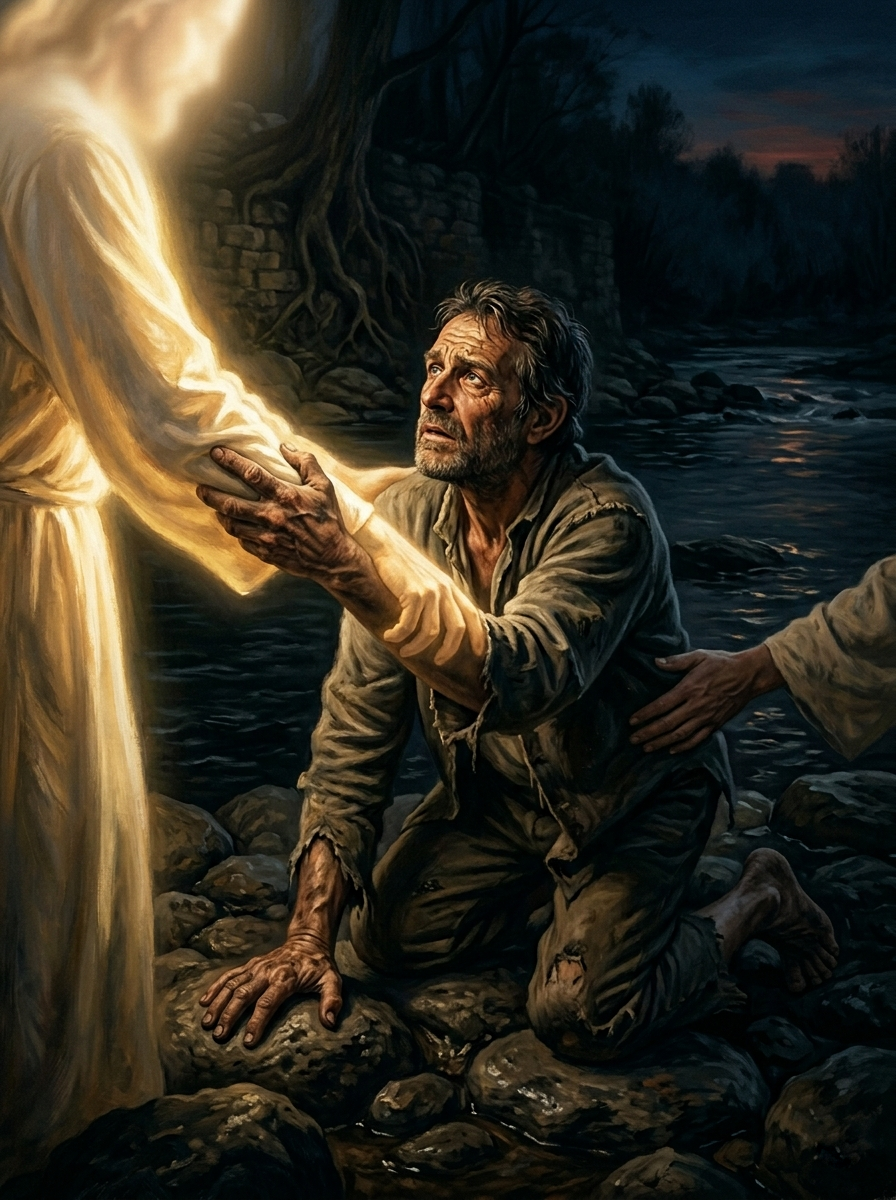
Consider the woman who had suffered from a hemorrhage for twelve years. When she finally touches the hem of Jesus's garment, the bleeding stops immediately—a sudden, physical, unmistakable healing. But Jesus will not let the moment close there. He stops. He turns. He asks who touched him, and when she comes forward trembling, he reframes the entire event. Your faith has made you well. He is not correcting anyone's account of what just happened. He is expanding it. What looked, from the outside, like a single bold act in a crowd was the visible tip of something much deeper—a faith that had been forming, pressing, building beneath the surface long before she ever reached for him.
But the moment does not end with the healing. Jesus calls her daughter. In a single word, he offers her an entirely new identity—not a sick woman declared clean, but a daughter of the kingdom, with all the belonging and inheritance that entails. This is where the weight of the text becomes most demanding. Because she has to go home and be that. She has to take what happened suddenly and nurture it slowly into who she actually is. She has to resist the pull back toward her old self-understanding and inhabit the new name. The healing was sudden. The becoming is a life.
This is one of the central disciplines of the Christian walk: learning to sustain what God gives suddenly by tending to it quietly. Too often, the encounter becomes the thing we long for, rather than the door we walked through. We return to God the way some people return to a feeling—chasing the intensity of the first experience rather than growing into the person the experience was meant to produce. But God is not trying to give us moments. He is trying to give us transformation. These are not the same thing.
The Apostle Paul understood this with a clarity born from personal history. His encounter on the road to Damascus remains one of the most dramatic conversion accounts in all of Scripture—a blinding light, a voice, a man stopped in the middle of a mission, and turned completely around. The Greek and Latin traditions both preserve the word "conversion" to describe that moment, and it is an accurate word: "conversio," to turn toward. Paul turned. His direction changed absolutely and irreversibly.
But conversion is not transformation.
What Paul did next is as significant as what happened to him. In his letter to the Galatians, he is careful to tell his readers that he did not immediately go to Jerusalem, did not seek out the apostles, and did not place himself in the current of the existing Christian community and interpretation. He went to Arabia. He spent years in that quiet distance, alone with what God had done to him, letting it settle, letting it deepen, allowing his entire understanding of Scripture, law, covenant, and mission to be reorganized from the inside. He was not avoiding the church. He was protecting a work that had barely begun from being short-circuited by premature influence—even well-meaning influence. He understood that what had happened to him was not finished happening.
This is the pattern. Not that community is bad or that formation happens only in solitude, but that there is a kind of interior work that cannot be rushed or skipped. The suddenly must be cared for before it can be shared. What God does in a moment must be grown into over years.
It is worth being precise here about what kind of work this is, because the language of effort can mislead. The new birth Jesus describes in his conversation with Nicodemus—that essential becoming that he places at the entrance to the kingdom of God—is not something a person achieves. The wind blows where it wishes, Jesus says, and you do not know where it comes from or where it goes. So it is with everyone who is born of the Spirit. Regeneration is God's sovereign act. It is not a process we undertake; it is something done to us, and only God can do it.
What follows the new birth, however, requires everything we have. Sanctification—the long work of being made holy, of having our character, perceptions, and reflexes brought into conformity with Christ—is genuinely costly. Paul does not sit in Arabia and wait for holiness to arrive. He presses into it. The transformation he experiences is not passive. It is the yielded, active cooperation of a man who has decided that he wants to be whatever God is making him, regardless of what that costs him.
And what God is making him, in practical terms, is a man whose senses have been rerouted.
The writer of Hebrews makes a striking observation: solid food belongs to those who are of full age, those who by reason of use have their senses exercised to discern both good and evil (5:13-14). The word "translated" senses here is broad—it encompasses perception in the fullest meaning of the term, the entire apparatus by which a person takes in and interprets the world. Maturity, by this account, is not primarily a matter of knowing more. It is a matter of perceiving more accurately.
This is what transformation looks like from the inside. It is not simply a new set of beliefs installed into an otherwise unchanged person. It is a reorientation of the whole perceptual self—the way we see people, the way we hear situations, and the way we read what is happening beneath the surface of what appears to be happening. Jesus healed lepers with a touch at a time when touching a leper was not merely unusual but ritually unthinkable. He was not only healing one person. He was modeling, for everyone watching, a different way of touching the world—with hands unconstrained by categories of clean and unclean, free to carry healing into places that fear refuses to enter. When Zacchaeus climbs a tree to see over the crowd, Jesus looks up and calls him by name, seeing in a tax collector what no one else in Jericho can see. When a woman is dragged before him by men with stones in their hands, he hears in the noise of accusation what they cannot hear: the shame she is carrying, the humanity that the charge has been designed to erase.
The transformed person begins to see, hear, and touch the way Jesus does—not perfectly, not all at once, but increasingly, as the senses are exercised through years of quiet faithfulness and deliberate surrender.
Paul, by the time we find him in Acts 16, has become that kind of person. He and Silas are in prison, beaten, chained in the innermost cell. An earthquake comes. The doors fly open. The chains fall off. And Paul does not leave. He sits in an open prison and waits because his discernment has sharpened to the point where he can perceive that God is not finished with this moment. The jailer, terrified, rushes in assuming his prisoners have fled. Paul calls out from the dark to stop him from taking his own life. We are all here. What follows is the conversion of an entire household.
This is the fruit of transformation that was tended over years of obscurity and suffering—a man so thoroughly reorganized by God that even his instincts have changed. He does not fight his way out of chains. He does not calculate escape. He perceives what God is doing and aligns himself with it, at significant personal cost, because the senses of Christ have become his senses.
The architecture of all of this is the same. Quiet momentum, largely invisible, building toward a moment of sudden revelation. Then the sudden moment becomes the starting point for a new season of quiet faithfulness. Conversion leads to the call to be transformed. Transformation requires that the senses be exercised. The exercised senses produce discernment. Discernment makes a person genuinely useful in the hands of God—not just available to have encounters, but capable of being sent.
This is why the hidden work matters more than it appears to. The prayer that no one sees. The word of Scripture returned day after day in the ordinary mornings of an unremarkable week. The habit of repentance that quietly dismantles old patterns of perception and replaces them with something cleaner. None of it looks like much from the outside. All of it is the interior architecture that makes the sudden moment possible—and makes it last.
What God does in private qualifies what he does in public. Not because performance requires preparation, but because transformation requires time. The person who stands in the sudden moment without having tended to the subtle work will feel like an imposter, because in a meaningful sense they are—the public moment has outrun the interior reality. But the person who has done the quiet work finds that the sudden moment fits them. They are not overwhelmed by it. They expected it, in some deep and unspoken way, because they have been becoming the person the moment requires for a very long time.
The work God is doing in you right now may not be visible. It may not feel like progress. It may feel, honestly, like nothing at all. That is often exactly what transformation feels like from the inside. But the wind is moving where it wills, and what is being built in the quiet places will not stay quiet forever.
Tend to what you have been given. The sudden is coming.



Comments